Mobile app development
UI/UX Design
Marketing strategies
Data analytics
Product strategy
Gamified Mobile Apps for Sponsor Campaigns
Iliya Timohin
2026-05-21
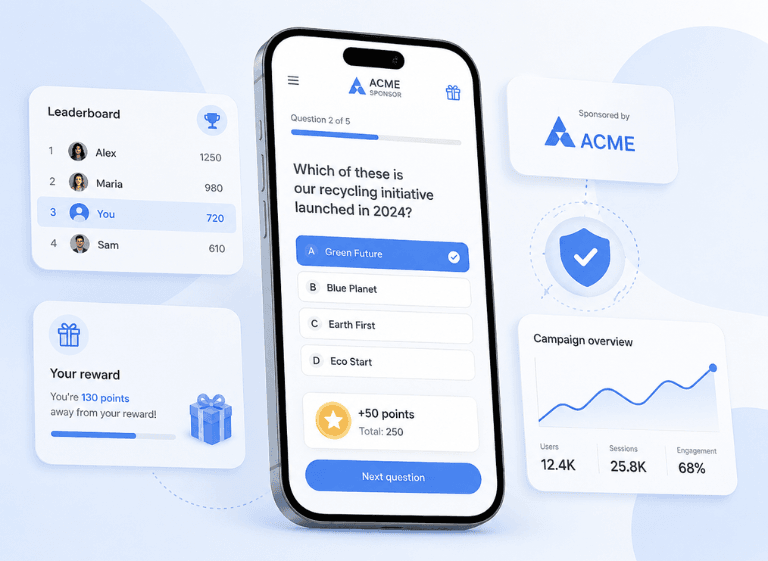
Sponsor campaigns often struggle when a brand gets visibility but cannot measure meaningful participation, repeat interaction, or user behavior after the first touchpoint. Gamified mobile apps can solve this gap when a campaign needs more than a landing page or banner placement: branded quiz mechanics, reward logic, campaign controls, and clear mobile app engagement data. The value is not in adding game elements for decoration, but in building a sponsor-driven mobile product where users interact with the brand, return for new sessions, and generate signals the team can actually analyze. This article explains what businesses should plan before developing this type of product, from UX and admin panels to rewards, referral safeguards, and sponsor reporting.
Why Sponsor Campaigns Use Gamified Mobile Apps
A custom app makes sense when a sponsor campaign needs more than one-off awareness. If the goal is repeated participation, measurable interaction, clear reward rules, and reusable campaign control, gamified mobile apps can give brands a stronger product foundation than a landing page or banner placement. Research on game rewards also shows why reward design should be treated as part of the product logic, not as a decorative engagement layer.
This does not mean every sponsor campaign needs an app. For a short awareness push, a lighter web format may be enough. A sponsor-driven app becomes more relevant when the campaign needs recurring sessions, branded interaction, audience data, and operational control that can be reused across future launches. That is where thoughtful mobile development matters: the campaign needs product logic, UX, analytics, and backend processes that can support more than a single promotion.
How Branded Quiz Apps Increase Campaign Engagement
Branded quiz apps can turn passive exposure into active participation. Instead of only seeing a logo, users answer questions, interact with sponsor content, collect points, and qualify for campaign rewards under clear rules. This fits the broader role of branded mobile apps, which can combine contests, games, real-time promotions, and social interaction into a more participatory brand experience.
Recurring quiz sessions can give users a reason to return when the content cadence, reward logic, and campaign rules are clear. For the business, this creates more measurable engagement because participation, completion, repeat sessions, and interaction with branded content can be tracked as campaign signals instead of guessed from impressions alone.
The difference is easier to see when a standard sponsor campaign is compared with a gamified mobile campaign:
| Aspect | Standard sponsor campaign | Gamified mobile campaign | Business value |
|---|---|---|---|
| User interaction | Passive exposure | Active participation | More meaningful engagement |
| Sponsor visibility | Logo or banner | Branded quiz mechanics | Stronger branded interaction |
| Campaign control | Manual updates | Admin panel controls | Faster campaign operations |
| Rewards | Basic giveaway | Rule-based rewards | Clearer user motivation |
| Reporting | Impressions or clicks | Participation and behavior data | Better campaign insights |
When Sponsor Campaign Apps Need Custom Logic
Many brands start with ready-made builders or quiz templates, but these tools often reach operational limits once the campaign needs custom rules. The product may need different reward rules by audience segment, region, or campaign partner; integrations with CRM or analytics systems; role-based access for several brand teams; and reporting that separates sponsor-specific data.
This is where custom mobile app logic becomes important. Multi-step referral programs, reusable campaign controls, sponsor asset management, and data isolation are difficult to handle with a generic template. A custom product approach is justified when the app is not only a quiz interface, but a campaign system that must support repeated launches, governed access, and measurable performance. This also connects with branded app ROI: an app needs repeat usage, useful content, and trustworthy data handling to justify long-term investment.
Branded Quiz App UX for Sponsor Campaigns
A sponsor-driven quiz app has to keep the campaign visible without making the experience feel like a banner wrapped in a game. The interface should help users understand the rules quickly, start a session without friction, see reward states clearly, and recognize the sponsor’s presence without interrupting the quiz flow. Strong UI/UX design is important here because campaign UX has to balance user motivation, sponsor visibility, fast feedback, and trust in the interaction.
How Real-Time Quiz Scoring Improves Engagement
Real-time quiz scoring can help maintain attention during live sessions because users see feedback while the interaction is still active. When score updates, answer validation, and session progress feel immediate, participants have a clearer reason to complete the quiz and compare their performance with others.
A real-time quiz platform shows why scoring, sponsor mechanics, rewards, and mobile UX need to work as one connected product system. The point is not only to display scores quickly, but to keep the experience consistent across the user interface, backend logic, campaign rules, and reward states.
Why Quiz Leaderboards Need Fair Scoring Rules
A quiz leaderboard can motivate users only when the scoring logic feels fair and predictable. If score updates are delayed, race conditions appear, or results look inconsistent, user trust can drop quickly. Fair scoring rules should define how answers are validated, how ties are handled, how suspicious activity is reviewed, and how campaign rewards are assigned to eligible participants.
This is where the leaderboard becomes more than a visual ranking. It becomes part of the trust model for the whole campaign product. Suspicious results, repeated attempts, and unusual scoring patterns should be reviewed through backend rules and moderation logic so the campaign does not reward manipulation or damage sponsor credibility.
Admin Panels for Sponsor Campaign Mobile Apps
A sponsor-driven mobile product usually needs an admin panel when campaigns have to change faster than the app release cycle. The admin panel becomes the operational layer where teams manage quiz content, sponsor materials, campaign schedules, moderation, rewards, and reporting without asking developers to update every small detail.
How Admin Panels Manage Prizes and Quiz Content
An effective admin panel should support the teams that run the campaign day to day. In practice, it may include:
- Quiz content management: creating and editing question banks, approving answers, and setting campaign schedules.
- Sponsor asset management: uploading branded visuals, sponsor messages, banners, and other campaign materials.
- Reward management: defining reward rules, limits, eligibility conditions, and moderation workflows.
- Reporting access: giving campaign teams visibility into participation, completion, referral activity, and branded content engagement.
Why Marketing Teams Need Campaign Controls
Marketing, operations, and sponsor teams need enough operational control to keep campaigns relevant without turning every update into a development task. Through admin panel controls, they can update quiz content, adjust sponsor materials, schedule campaign phases, review participation data, and prepare reports without waiting for a new app release.
This control should still be governed. Different users may need different permissions: a marketing manager can update campaign content, an analyst can access reports, and an external sponsor representative may only view sponsor-specific data. This is why custom roles matter in these products: they help separate responsibilities, protect access, and keep non-technical teams productive without giving everyone the same level of control.
Reward Logic in Gamified Mobile Apps
Reward logic should be separated from payout handling. In many campaign apps, rewards may be non-cash incentives such as discount coupons, branded merchandise, digital badges, loyalty points, early access, or partner promo codes. Direct payouts, if they exist at all, should be treated as an optional operational layer with additional product, trust, and abuse-prevention risks.
How Mobile Reward Logic Builds User Trust
User trust depends on clear and predictable reward states. Participants should understand:
- what makes them eligible for a reward;
- whether their reward is pending, approved, delivered, or unavailable;
- why a reward may be delayed, rejected, or limited by campaign rules.
Clear reward logic reduces confusion because users can see how campaign rewards are earned and what happens next. It also protects the sponsor’s reputation: unclear reward rules can make a campaign feel unfair even when the technical system works correctly. This is why reward design should stay connected to campaign UX, eligibility rules, support workflows, and mobile app engagement goals.
When Payout Handling Affects Reward Trust
If a campaign includes cashback, partner bonuses, or another payout flow, the app needs stricter handling of edge cases. Failed payout handling, duplicate requests, unclear reward status, and repeated claim attempts can damage trust quickly, especially when users cannot see what happened or when the issue will be resolved.
Valuable rewards can also attract abuse attempts. The app should account for fake accounts, repeated self-referrals, multi-accounting, duplicate reward claims, and incentive farming before launch. Guidance on referral fraud prevention shows why referral programs need limits, monitoring, verification, and risk-based review. The goal is not to make the product feel restrictive, but to protect the campaign budget, eligible participants, and sponsor credibility.
Campaign Analytics for Sponsor-Driven Mobile Apps
Vanity metrics such as downloads or impressions are not enough to evaluate a sponsor-driven mobile product. Sponsors need analytics that show how people participate, where they drop off, whether they return, and how they interact with branded content. In a gamified campaign app, the most useful data usually comes from target actions inside the quiz journey: session starts, completed quizzes, answer patterns, referral activity, reward interactions, and sponsor content engagement.
This is why <a href="https://firebase.google.com/docs/analytics/ios/events" target='_blank" rel="noopener noreferrer">app event tracking should be planned before launch, not added after the campaign is already running. Event data helps teams connect user actions with campaign goals, build behavioral funnels, and prepare sponsor reporting that goes beyond surface-level reach.
What Sponsor Campaign Reports Should Include
Reports should focus on participation quality, not just audience size. Useful reporting may include:
- Participation data: the number of unique participants, started sessions, and completed quiz sessions.
- Behavioral data: quiz completion rate, average session duration, answer patterns, and drop-off points.
- Referral activity: invited users, repeat participation, and suspicious referral patterns that may need review.
- Branded content engagement: interactions with sponsor materials, campaign messages, partner links, and branded quiz elements.
How Engagement Data Improves Sponsor Campaigns
Campaign analytics are useful not only after a campaign ends, but also while the product is still active. Teams can use engagement data to adjust quiz difficulty, improve onboarding, update sponsor assets, refine reward rules, and identify where participants lose interest.
Retention analysis is especially important when a sponsor campaign aims for repeat interaction rather than one-time exposure. Tracking retention cohorts helps teams understand which users come back, how often they return, and which campaign mechanics support continued participation. This makes sponsor ROI easier to evaluate without relying only on impressions, clicks, or broad download numbers.
Conclusion
Gamified mobile apps for sponsor campaigns are not just interactive campaign wrappers. They are custom product systems that connect branded quiz UX, reward logic, admin controls, referral safeguards, campaign analytics, and scalable backend processes. When these parts are planned together, a sponsor-driven app can support repeat interaction, clearer reporting, and more controlled campaign operations.
For businesses, the main question is not whether to add game mechanics. The more important question is whether the campaign needs reusable product logic, governed admin access, transparent rewards, and data that sponsors can use after launch. Pinta WebWare can support this type of work as a product and engineering partner for teams that need mobile UX, backend logic, analytics, and long-term product support behind sponsor-driven mobile campaigns.

FAQ
What is a sponsor campaign app?
A sponsor campaign app is a mobile product for branded campaigns that need more than passive visibility. It combines user interaction, campaign rules, rewards, and reporting in one controlled experience.
How do gamified mobile apps support sponsor campaigns?
Gamified mobile apps turn passive exposure into active participation through quizzes, rewards, repeat sessions, and measurable engagement data. They work best when a campaign needs ongoing interaction, not one-time awareness.
What should a branded quiz app include?
A branded quiz app should include clear rules, fast onboarding, reliable scoring, fair leaderboards, sponsor asset management, reward logic, and campaign analytics. If referrals or valuable rewards are involved, anti-abuse safeguards are also needed.
Why do sponsor campaign apps need an admin panel?
An admin panel lets marketing, operations, and sponsor teams update quiz content, schedules, rewards, materials, and reports without waiting for developers. Role-based access keeps each team within the right level of control.
Why do referral rewards need anti-abuse rules?
Referral rewards can attract fake accounts, self-referrals, duplicate claims, or other abuse patterns. Anti-abuse rules protect the reward budget, eligible participants, and sponsor credibility.