SEO optimization
AI tools
E-Commerce Solutions
DevOps practices
Marketing strategies
Data analytics
Performance optimization
Real project examples
AI Localization for E-commerce SEO: Risks, Hreflang, and QA
Nadiia Sidenko
2026-01-25
E-commerce teams in 2026 face a paradox: AI localization for ecommerce promises expansion into dozens of markets within days, yet creates risks of semantic collapse, duplicate content penalties, and hreflang conflicts that can erase years of SEO investment. Speed without strategy leads to scaled content abuse—where 20 linguistically accurate translations fail because they lack local search intent, causing Google to consolidate them into a single "dominant" version. This guide walks through the critical quality assurance checkpoints, technical SEO safeguards, and prioritization frameworks that separate successful multilingual seo for ecommerce from expensive failures.

Why Does AI Localization Create SEO Risks for E-commerce?
AI localization scales e-commerce catalogs to 10+ languages in days, but creates three critical risks: keyword intent mismatch (translated terms target zero-volume queries), semantic collapse (Google consolidates duplicate versions), and tone inconsistency across markets. Neural machine translation tools increased productivity from 400 words per hour in manual workflows to 1,000 words per hour, enabling catalog-wide localization in hours rather than weeks.
This efficiency masks structural problems. AI systems optimize for linguistic accuracy, not keyword intent—a perfectly translated product description may target low-volume or zero-traffic queries in the destination market. Content localization SEO risks emerge when UI strings and category hierarchies translate literally, creating navigation patterns that conflict with local user behavior. Premium brand voices shift between formal and casual across markets, eroding trust and conversion rates.
If your product catalog requires market-specific business logic beyond translation—such as regional pricing rules, compliance disclaimers, or inventory visibility by geography—consider custom web development to embed these controls at the database layer rather than patching them post-translation. When UI elements like checkout flows need cultural adaptation, teams often need AI-driven product UX expertise to ensure localized interfaces match user expectations.
Key risks of AI-powered seo localization:
- Scales product catalog localization across 5-10 languages in days, but without keyword intent validation
- Creates inconsistent keyword match when query intent differs between markets
- Over-translating low-value pages creates duplicate content and crawl budget waste
- Without glossaries, brand names and technical terms suffer mistranslation that damages positioning
What Hreflang Errors Break International SEO in 2026?
Hreflang implementation errors cause regional pages to compete instead of complement each other, with three critical failures dominating: hreflang loops (broken reciprocal links), URL format mismatches (relative vs absolute paths), and canonical-noindex conflicts that Google flags as invalid. AI risks in hreflang and international SEO include reduced influence in AI-mediated retrieval systems like Google's AI Overviews, where content selection happens before hreflang evaluation.
In a 2023 audit of a multi-regional travel booking platform covering Central Asia, the Caucasus, and Mongolia with over 2,000 local service providers, we identified hreflang loops affecting regional tour pages—Russian versions pointed to Kazakh alternates, but Kazakh pages lacked reciprocal links. Google Search Console flagged these as invalid, causing regional pages to compete rather than complement each other.
Three implementation errors plague international seo for ecommerce sites:
- Hreflang loops: Page A points to Page B as the German alternate, but Page B points to Page C instead of back to Page A, breaking the reciprocal relationship Google requires
- Using relative paths (/de/product) in hreflang when canonicals use absolute URLs (domain.com/de/product)
- Canonical + noindex conflicts: A German page with <link rel="canonical" href="https://example.com/en/product"> plus <meta name="robots" content="noindex"> sends contradictory signals—Google may ignore the hreflang entirely
Validation checklist for hreflang ecommerce setups:
- Always use full absolute URLs in hreflang annotations, matching canonical format
- Implement bidirectional confirmation: if EN points to DE, DE must point back to EN
- Audit every page flagged in Search Console's "International Targeting" report
- Use Screaming Frog to detect canonical conflicts with localized pages
How Does Translate AI Plugin Work for OpenCart Localization?
The translate ai plugin for opencart provides three operational modes—manual review, AI-assisted drafts with human approval, and hybrid workflows where glossary terms lock automatically while descriptions use machine translation post editing—preventing brand name mistranslations that plague bulk AI workflows. The Translate AI – Smart Website Translation Powered by AI integrates directly into OpenCart's admin panel for teams managing 1,000+ SKUs across multiple markets.
The plugin connects to ChatGPT, DeepL, and Lecto translation engines, allowing teams to A/B test quality across providers per content type. Technical specifications may perform better with DeepL's precision, while lifestyle-oriented category pages benefit from ChatGPT's contextual fluency. SEO URL localization happens simultaneously—English slug /luxury-watches becomes /relojes-de-lujo in Spanish with proper character encoding and 301 redirect mapping.
Core capabilities for AI translation for ecommerce implementations:
- Built-in glossary control with term-locking for brand names and regulated language
- QA flags for sensitive terms (pricing, legal disclaimers, sizing charts)
- Works with OpenCart's native SEO URLs and meta field structure
- Version history to rollback translations that underperform in GSC
What Should a QA Workflow for Multilingual SEO Include?
A qa workflow localization strategy requires five checkpoint stages: glossary setup for branded terms, contextual match validation for UI elements, SEO keyword intent verification per market, hreflang mapping audits, and content inventory prioritization based on traffic data. A QA-first translation workflow with glossary and human-in-the-loop checkpoints prevents the compounding errors that occur when teams batch-translate thousands of pages then audit reactively.
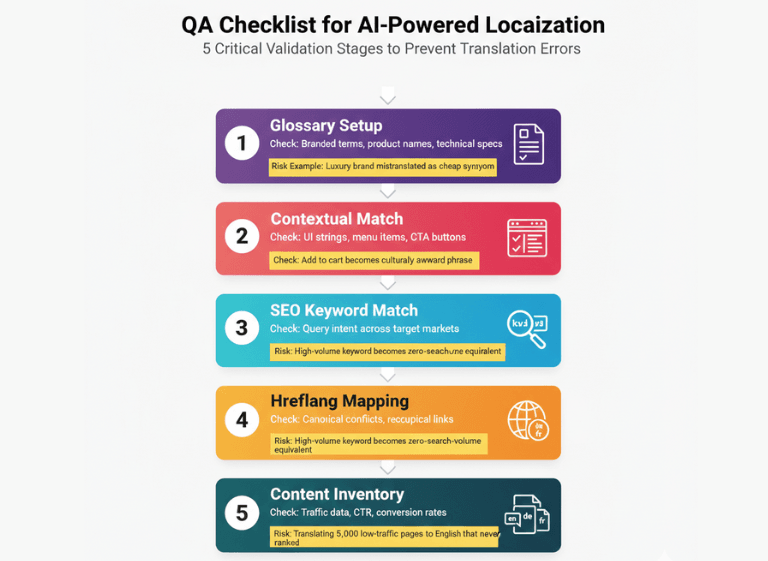
The table below outlines the five critical stages and their real-world failure modes:
QA Checklist for AI-Powered Localization
| Stage | What to Check | Tools / Tips | Real Risk Example |
|---|---|---|---|
| Glossary Setup | Branded terms, product names, technical specs | Pre-translation glossary lock in TMS | Luxury brand name translated as "cheap" synonym, destroying positioning |
| Contextual Match | UI strings, menu items, CTA buttons | Page previews in staging environment | "Add to cart" becomes grammatically correct but culturally awkward phrase |
| SEO Keyword Match | Query intent across target markets | Local keyword research tools (Ahrefs, Semrush for region) | High-volume EN keyword translated to zero-search-volume DE equivalent |
| Hreflang Mapping | Canonical + noindex conflicts, reciprocal links | Screaming Frog, Google Search Console International Targeting | German page canonical points to English, hreflang ignored by Google |
| Content Inventory | Which pages justify localization cost | GSC traffic + CTR data, GA4 conversion rates | Translating 5,000 low-traffic blog posts that never ranked |
The "Contextual Match" stage catches human in the loop translation failures where AI produces syntactically perfect text that violates cultural norms—for example, overly formal language in markets that expect casual brand communication. This stage requires native speakers or market experts, not just linguists.
How Should E-commerce Teams Prioritize Pages for Localization?
E-commerce teams should prioritize localization using a three-tier system: Tier 1 targets high-traffic category pages and bestsellers (GSC impressions above 10k, CTR exceeding 3%), Tier 2 covers conversion-critical pages like size guides and checkout flows, and Tier 3 addresses long-tail content only after validating demand through paid search tests. A seo localization strategy built on data prevents the resource drain of translating low-impact pages.
When expanding a travel booking platform across Central Asia, we prioritized localization based on booking volume by region for the Indy Guide marketplace. Category pages for high-demand destinations (Kazakhstan, Kyrgyzstan) were localized first using Laravel backend with Vue.js frontend, while long-tail tour operator profiles were translated only after validating search demand through Google Ads campaigns in target languages. This tiered approach reduced translation costs while maintaining potential organic traffic coverage.
Start with high-traffic, high-CTR pages that already boost visibility in your home market—these have proven search demand and conversion optimization. Implement localization tiering based on SEO impact to allocate translation budget where it drives measurable returns.
Prioritization framework for qa workflow localization:
- Start with pages generating the majority of organic revenue in your primary market
- Avoid translating outdated content—refresh in source language first
- Focus on conversion-critical pages (checkout flows, trust signals) before informational content
- Use GA4 e-commerce tracking to identify which page types drive purchases per market
For teams expanding into new geographies, test one high-intent category with localized paid ads before committing to full catalog translation. If German paid search for "leather handbags" converts at minimal rates, the organic localization likely won't justify its cost.
Why Does Scaled AI Content Trigger Google Penalties?
Scaled AI content triggers Google penalties when 20 language versions lack local entity signals (pricing in local currency, regional inventory, local reviews), causing semantic collapse where Google consolidates all versions into one "dominant" page and suppresses others. Google's March 2024 spam update explicitly targets mass-produced AI content lacking unique value—and multilingual sites face double scrutiny. Industry data shows 60% of translation workflows now incorporate machine translation, making quality controls critical to separate compliant implementations from penalties.
For platforms with local service providers—such as tour guides, drivers, or marketplace vendors—each localized page must include region-specific signals: pricing in local currency (KZT for Kazakhstan, KGS for Kyrgyzstan, MNT for Mongolia), availability by season, and local business verification markers. Without these, AI-translated versions appear as duplicates despite linguistic accuracy, causing Google to consolidate regional pages into a single "strongest" version.
Entity clarity prevents AI systems from merging your markets. Each localized page needs unique signals: customer reviews in the local language, region-specific structured data (offers with local currency and availability), and backlinks from local domains. Without these, Google's AI-driven retrieval systems may select one version and suppress others, regardless of correct hreflang implementation.
As you scale localization, monitor website performance to avoid bloating page weight with redundant language scripts or unoptimized translated images. Deploy E-E-A-T guardrails for AI multilingual SEO by attributing local authors to market-specific content, displaying local business addresses in footer structured data, and publishing region-specific case studies or testimonials.
Strategic SEO re-optimization beats blind scaling: validate search demand before translating, adapt keyword targeting per market, and add local proof elements that signal genuine market presence rather than automated expansion.
Frequently Asked Questions
Can AI translation replace human translators for e-commerce SEO?
No. AI translation for ecommerce handles linguistic conversion but fails at keyword intent mapping—a product description may translate accurately yet target zero-volume queries in the destination market. Human oversight is required for glossary control, cultural tone adaptation, and SEO keyword validation per locale. Professional translators are familiar with AI tools, but only a fraction use them daily due to quality concerns that affect conversion rates.
What is hreflang and why does it matter in 2026?
Hreflang tags tell Google which language version to show users, preventing duplicate content penalties across regional pages. However, in 2026, hreflang has reduced influence in AI Overviews—if one language version dominates entity signals or freshness metrics, AI systems may ignore hreflang entirely and consolidate all versions into a single result. Correct implementation requires bidirectional links, absolute URLs, and regular audits through Search Console.
How long does AI-powered localization take compared to manual translation?
AI-assisted translation processes content 10-50x faster than manual teams, compressing projects from weeks to days. However, quality assurance extends timelines—QA workflows for glossary validation, contextual match review, and SEO keyword verification can add 30-40% to total project time. Teams should budget for human review cycles to avoid launching translations that harm conversion rates or trigger Google penalties.
Should I translate all product pages or prioritize by traffic?
Prioritize by traffic and conversion potential using a three-tier system. Translate high-traffic category pages and bestsellers first (Tier 1), followed by conversion-critical pages like shipping policies and size guides (Tier 2). Long-tail product descriptions should only be localized after validating demand through paid search tests in target markets (Tier 3). This prevents wasting translation budget on pages that generate fewer than 100 monthly impressions.
What tools validate hreflang implementation?
Use Screaming Frog for crawl-based hreflang audits to detect loops, URL mismatches, and canonical conflicts. Google Search Console's International Targeting report flags pages with invalid hreflang annotations. For ongoing monitoring, set up alerts for hreflang errors and regularly audit pages with declining impressions in target markets—these often signal technical issues that block proper language targeting.
How do I prevent AI-translated content from being flagged as spam?
Add unique local entity signals to each language version: pricing in local currency, region-specific availability and shipping terms, customer reviews in the target language, local business verification markers, and structured data with local offers. These signals prevent semantic collapse where Google consolidates 20 similar translations into one dominant version. Avoid bulk-translating low-value pages without validating search demand first.

Conclusion — SEO Localization Needs a Brain, Not Just a Bot
AI delivers the speed to translate 10,000 pages overnight, but without a qa workflow localization strategy anchored in search intent validation, hreflang hygiene, and entity differentiation, that velocity creates liabilities. The difference between successful multilingual seo for ecommerce and scaled content penalties lies in treating localization as a strategic SEO initiative—not a linguistic task.
If your e-commerce platform faces hreflang conflicts, needs market-specific product logic that AI translation can't address, or requires a QA-first approach to international expansion, Pinta WebWare combines custom web development, OpenCart ecosystem expertise, and data-driven SEO methodology to deliver measurable multilingual growth. Our experience building scalable travel marketplaces and multi-regional platforms demonstrates how strategic localization drives sustainable international performance. Reach out to discuss how your catalog can scale globally without sacrificing search visibility.