Web development
Performance optimization
SEO optimization
Real project examples
Product strategy
Data analytics
Website Monitoring for SEO: How MySiteBoost Protects Traffic
Iliya Timohin
2025-12-08
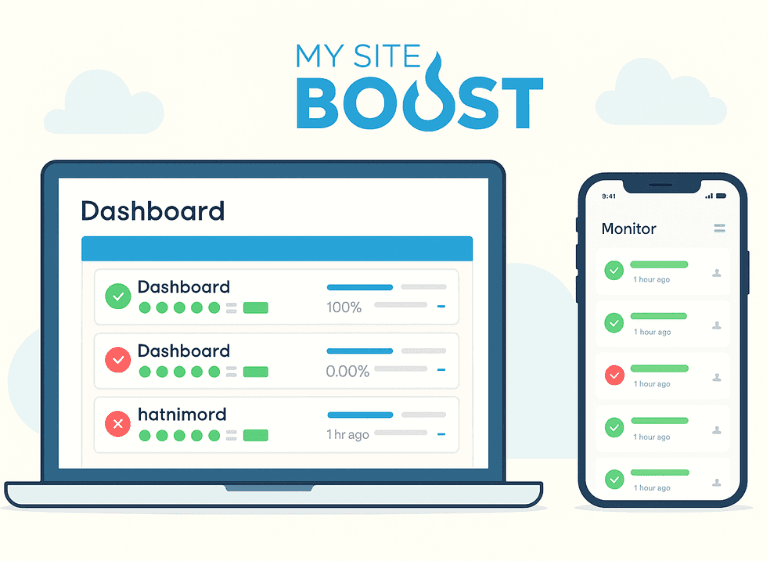
SEO monitoring isn’t rank tracking. It’s ongoing checks of uptime, speed, indexing, metadata, and key on-page changes that can quietly break rankings before Search Console shows a clear signal. In practice, it means catching regressions early: a noindex shipped by mistake, a canonical swapped after deployment, a title overwritten, or a landing page slowing down after a release. In this article, we break down what to monitor, how alerting should work for SEO teams, and where traditional monitoring tools fall short — with MySiteBoost as our SEO-first approach built around those checks.
What is SEO monitoring?
It’s tracking the technical and content signals that directly affect search visibility and rankings. Unlike rank tracking (which observes position changes after they happen), SEO monitoring helps catch issues before they turn into traffic drops.
Core signals SEO monitoring tracks:
- Uptime & HTTP status: Ensures key landing pages remain accessible to search engines and users
- Mobile page speed & Core Web Vitals: Google uses these metrics as ranking factors, making performance monitoring critical for SEO
- Indexing signals: Detects robots.txt changes, noindex tags, or canonical issues that block pages from search results
- Metadata & schema: Tracks title tags, meta descriptions, and structured data to prevent snippet loss in SERPs
- SSL/domain expiry: Expired certificates or domains cause trust issues and complete site unavailability
- Content changes: SEO change monitoring alerts teams when important content blocks, keywords, or internal links are modified or removed
Automated SEO monitoring alerts enable teams to respond to ranking-critical incidents immediately, rather than discovering problems weeks later through GSC reports.
Why Website Monitoring Is Critical for SEO
SEO relies on stable technical performance, content integrity, and consistent indexing signals — issues that traditional monitoring overlooks.
Search visibility can drop when pages slow down, return intermittent errors, or when crucial metadata changes unexpectedly. For businesses that rely on organic traffic, every hour with broken structured data or a slow landing page translates into lost conversions. Without SEO-aware monitoring, teams detect such issues too late, when rankings have already dropped.
Most monitoring tools stop at uptime; SEO monitoring has to cover what actually changes visibility — performance regressions, indexing monitoring (robots.txt, noindex, canonicals), metadata and schema changes, and SEO change monitoring on key landing pages.
How We Built an SEO-Focused Monitoring Tool
We mapped real SEO risks to measurable signals and built checks that treat SEO as a technical process — not just marketing.
Our development approach started with analyzing traffic drops from multiple client projects. We found that most cases were caused by a combination of technical regressions and overlooked content changes. This shaped the core design: MySiteBoost had to be a monitoring system that speaks the language of SEO teams.
We designed the architecture to detect technical issues that strongly affect rankings: uptime incidents, slowdowns across key landing pages, SSL or domain problems, and basic content or keyword-related risks on SEO-critical pages. UX was built from the SEO workflow perspective, not from an SRE dashboard template.
In our SEO monitoring case, MySiteBoost was designed around real SEO workflows, bridging the gap between technical incidents and ranking impact.
MySiteBoost Features: What It Checks and Why It Matters
MySiteBoost combines uptime and availability monitoring, performance checks, SSL and domain monitoring, and basic content or keyword signals in a single system that’s friendly for SEO specialists.
Key checks inside MySiteBoost:
- HTTP status and uptime monitoring for key pages and paths
- Performance checks focused on mobile page speed
- SSL certificate and domain expiry monitoring to avoid trust and availability issues
- Ping and port monitoring for critical web services and infrastructure
- Basic content and keyword checks on SEO-critical pages to catch risky changes
SEO change monitoring — MySiteBoost tracks changes to metadata (title, description), canonical tags, and schema markup on your most important landing pages. When these elements change unexpectedly during deployment, you receive immediate alerts before Google re-crawls and updates search results.
These features create a holistic view of SEO health, connecting technical SEO monitoring with search-focused telemetry.
MySiteBoost runs availability, performance, and content checks together — giving SEO teams a clearer picture of ranking-critical signals.
MySiteBoost vs Other Website Monitoring Tools
| Aspect | Generic Monitoring Tools | MySiteBoost | SEO Meaning |
|---|---|---|---|
| Uptime | Endpoint pings | Path-level checks for landing pages | Detects outages that matter for organic traffic |
| Performance | Synthetic tests | Mobile page speed with SEO prioritization | Highlights ranking-related performance issues |
| Content Signals | Not focused on SEO content | Basic keyword and page-level checks on SEO-critical pages | Helps catch risky changes on important landing pages before they impact organic traffic |
| Structured Data | Not SEO-focused | Works alongside SEO crawlers that validate schema | Technical monitoring keeps pages fast and available, while dedicated SEO tools handle rich result validation |
| Reporting | Ops-focused | SEO-friendly, traffic-centric | Transparent value for marketing teams |
To understand how generic monitoring services work, see this website monitoring tools overview.
Generic monitoring tracks servers; MySiteBoost highlights SEO-relevant technical and content signals that affect search performance.
SEO monitoring tools: what to look for
If you’re evaluating SEO monitoring tools, focus on whether they can detect ranking-critical regressions at the page level (not just “site is up”). The best fit is usually the tool that reduces time-to-detection and gives actionable context, not the one that generates the most alerts.
Key criteria to check:
- Path-level uptime checks for SEO landing pages (not only homepage pings)
- Indexing monitoring for robots.txt changes, noindex tags, and canonical shifts
- Metadata & schema change detection with clear diffs (title, description, structured data)
- Performance monitoring that highlights regressions on mobile and key templates
- Alert routing and ownership (who gets notified, and what “done” looks like)
- History and change logs that help confirm what changed and when
- Noise control (thresholds, baselines, and suppression to avoid alert fatigue)
Where Traditional Monitoring Tools Fall Short for SEO
Classical uptime platforms catch technical downtime but miss the SEO-critical layer: rewritten metadata, missing schema, or a canonical tag swapped after deployment. They also generate alert noise that SEO specialists cannot translate into ranking impact.
Typical limitations include:
- no explicit tracking for SEO-facing changes such as metadata or important content blocks
- limited visibility into how technical issues affect search snippets or structured data
- no clear view of which content updates correlate with traffic or ranking drops
- performance checks often not clearly tied to SEO metrics like Core Web Vitals
- no SEO-context reports for stakeholders
To understand how conventional tools position themselves, see the Pingdom vs Site24x7 comparison.
And for performance-centric monitoring approaches, see DebugBear’s feature set.
Traditional monitoring focuses on infrastructure stability, not search visibility — leaving SEO teams without actionable insights.
How MySiteBoost Compares to Other Tools
Short answer: each major monitoring tool excels in infrastructure, but none provides SEO-focused visibility.
MySiteBoost vs UptimeRobot
UptimeRobot excels at basic uptime checks. MySiteBoost extends this with landing-page prioritization, performance checks and SEO-relevant alerts, giving SEO teams more context around pages that drive organic traffic.
MySiteBoost vs Pingdom
Pingdom is strong in synthetic performance tests. MySiteBoost adds uptime, SSL/domain monitoring and SEO-aware reporting around key landing pages — crucial for protecting rankings during incidents.
MySiteBoost vs Site24x7
Site24x7 covers infrastructure and applications. MySiteBoost focuses on SEO-relevant monitoring, helping teams track incidents on user-value pages that drive organic traffic.
MySiteBoost vs Better Stack
Better Stack offers developer-friendly logging and alerting. MySiteBoost adds SEO-aware alerting and non-technical summaries designed for marketing and product teams.
MySiteBoost vs DebugBear
DebugBear emphasizes lab-based performance metrics. MySiteBoost blends real-world performance, uptime and incident monitoring with SEO-friendly views of affected pages — crucial for maintaining search visibility.
MySiteBoost complements traditional tools by adding SEO-centric signals that marketing, product, and content teams actually need.
When It Makes Sense to Build or Adopt an SEO-First Monitoring Tool
Short answer: high-traffic websites, marketplaces, SaaS products, and large content projects need monitoring tailored for SEO.
SEO-first monitoring becomes essential when:
- organic traffic is a primary acquisition channel
- content deployments happen frequently
- technical and content teams work in parallel
- silent regressions carry high financial impact
For large or custom projects requiring unique checks, teams often rely on custom web development to build tailored monitoring features.
If organic search drives your business, SEO-aware monitoring becomes a necessity — not an optional enhancement.
Product UI/UX: Why Monitoring Needs an SEO-Friendly Interface
Monitoring is often built for engineers, not marketers. To make insights accessible, we created a UI tailored for SEO workflows: page-level health, page health timelines, simplified alerts, and non-technical explanations.
A monitoring interface must help SEO teams act immediately, without translating technical alerts — which is why UI/UX design matters for monitoring products.
A clean, SEO-oriented UX enables faster decisions and reduces dependency on engineering teams.

Key Takeaways
- SEO monitoring requires more than uptime checks — it requires visibility into metadata, content, structured data, and Core Web Vitals.
- Alerts must reflect SEO impact, not only technical errors.
- MySiteBoost bridges the gap between DevOps monitoring and SEO visibility.
- For custom needs, a web development partner can extend monitoring logic with project-specific signals.
SEO-oriented monitoring protects both rankings and revenue by detecting silent regressions before search engines do.
FAQ
Why isn’t uptime monitoring enough for SEO?
Because SEO depends on metadata, indexing rules, structured data, and content — not just server availability.
What is tuptime? (And why it's not SEO monitoring)
Tuptime is a Linux command-line utility that tracks system uptime history, reboots, and shutdown statistics across server restarts. It provides detailed server availability metrics for DevOps teams but doesn't monitor SEO-critical signals like metadata changes, indexing status, or page speed regressions.
What uptime checks actually protect SEO traffic?
SEO-focused uptime monitoring tracks path-level availability for key landing pages (not just homepage pings), monitors HTTP status codes that affect indexing (404s, 5xx errors), checks SSL certificate validity to prevent trust warnings, and validates that critical content remains accessible to Googlebot. Generic uptime tools miss these SEO-specific signals.
Which SEO-related elements does MySiteBoost monitor?
MySiteBoost monitors uptime and HTTP status for key pages, mobile performance and page speed, SSL and domain status, and basic keyword-based content signals on important landing pages.
How do performance metrics connect to SEO?
Core Web Vitals directly influence rankings. MySiteBoost monitors mobile performance and speed indicators and flags regressions on key landing pages.
Does MySiteBoost replace traditional monitoring tools?
No — it complements them by adding SEO-critical checks missing in generic uptime or performance services.