Big data
Data analytics
AI tools
SaaS marketing
Real project examples
Product strategy
How AI and Big Data Transform B2B Lead Generation and Sales
Iliya Timohin
2025-11-24
For many B2B companies, lead generation still feels like a messy puzzle: scattered data, manual research, low-quality outreach lists, and sales teams overloaded with routine work. Today, however, AI in B2B sales and AI and Big Data in B2B lead generation finally allow businesses to turn millions of data points — from hiring signals to funding rounds — into predictable pipelines. In this article, we will break down how this shift happens in real systems and show what businesses can learn from two real products: Leads Otter and Opps.ai.
The challenge of classical B2B lead generation
Traditional B2B outreach methods struggle to scale. Manual LinkedIn research, static lists, outdated databases, and generic cold emails cannot keep up with dynamic markets. As soon as companies grow, these limitations become painfully visible.
Typical issues include:
- High cost per lead with no guarantee of relevance
- Slow research cycles and outdated information
- Low reply and conversion rates
- Sales teams drowning in routine tasks
- Lack of system-level data visibility across channels
As the complexity of markets grows, data-driven lead generation becomes not just an advantage — but a requirement.
The role of AI and Big Data in modern B2B sales
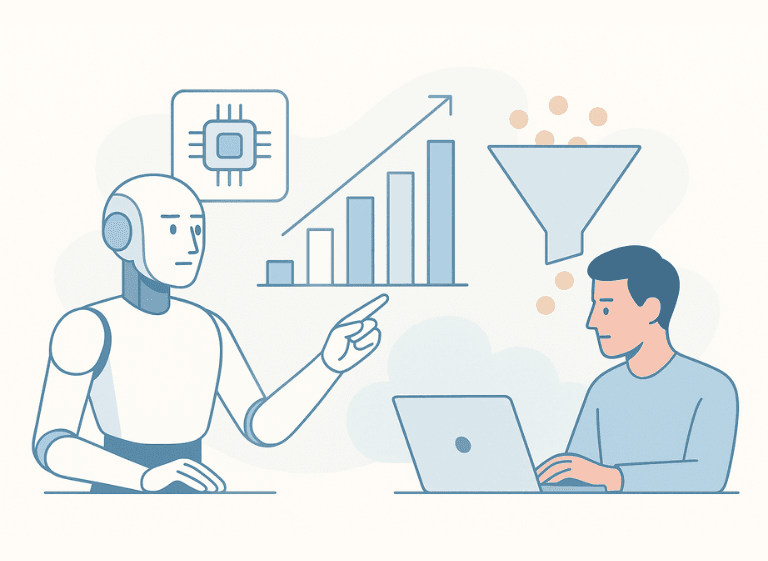
AI and Big Data reshape B2B sales by giving teams access to accurate, real-time insights and automated prioritization. With AI-driven ranking models, companies can automatically detect the highest-intent accounts, reduce research time, and focus sales teams on conversations rather than manual work.
This aligns with the broader shift toward ai b2b lead generation, where machine learning enhances scoring models, clustering, segmentation, and outreach personalization. Many companies use advanced technologies similar to those described in ai driven b2b solutions.
Big Data also plays a foundational role. Real-time information from hiring feeds, investments, and company profiles creates a fully connected system for big data in b2b sales and big data analytics for b2b sales. These datasets are continuously refreshed, enabling more accurate predictions and higher-quality targeting for b2b lead generation platforms and marketing teams.
Comparison: Classical approach vs AI + Big Data
| Aspect / Metric | Classical B2B Lead Gen | AI + Big Data Approach | Comment |
|---|---|---|---|
| Time to find leads | Hours per batch | Seconds / automated | Instant research dramatically reduces cycles |
| Data accuracy | Often outdated | Real-time refreshed | Hiring & funding signals improve timing |
| Scalability | Limited | Near-infinite | Automated enrichment enables rapid expansion |
| Lead quality | Inconsistent | Predictive scoring | ML improves prioritization |
| Cost per lead | High | Lower | Automated processes reduce manual labor |
Case Study: Leads Otter
Context and goals
Leads Otter is a system built to automate B2B hiring-based lead generation. Its idea is simple: hiring indicates demand. If a company posts dozens of job openings, it is actively investing and likely needs external services. The platform transforms this logic into an engine that identifies and prioritizes leads at scale — an approach described in using hiring data for b2b lead generation.
Real-time hiring data ingestion
The platform uses a Big Data pipeline that processes job openings in real time, scoring each opportunity using ML models. This allows b2b lead generation on hiring data, including the use of vacancy patterns, team growth trends, and technology stacks extracted from postings.
Impact on sales teams
Sales teams get fewer manual tasks and more precise targets. Instead of browsing LinkedIn for hours, they receive prioritized lists enriched with intent signals. As a result, conversions increase, and teams focus on qualified leads rather than noise.
Mini-summary: hiring data becomes a powerful, scalable source of intent, turning chaotic public signals into predictable revenue opportunities.
Case Study: Opps.ai
Context and goals
Opps.ai is built to provide intelligent targeting for outbound teams, using investment data, fast-growing companies, and audience insights. The platform acts as a dynamic data platform for b2b sales and marketing, aggregating multiple sources and enriching them with AI.
AI and integrations
Using OpenAI models and external APIs, Opps.ai analyzes companies' growth patterns, funding rounds, hiring velocity, and tech stack signals to determine which accounts are most likely to convert. It reflects the broader direction of ai tools for b2b lead generation and ai sales automation.
Marketing & sales benefits
Marketing teams get better audience segmentation, and outbound teams receive relevant, high-intent prospects. AI improves targeting quality, while automated workflows reduce time spent on manual research.
Mini-summary: Opps.ai shows how a data-driven outbound system can become a competitive advantage for growing companies.
Shared patterns and lessons for B2B businesses
Across both systems — Leads Otter and Opps.ai — several patterns repeat:
- Real-time data is crucial for timing and relevance
- AI/ML models act as the decision-making layer
- A strong data platform is the foundation for automation
- Integrations create an ecosystem rather than a standalone tool
These lessons suggest that any company investing in data driven b2b sales or b2b data driven marketing should prioritize data quality, system architecture, and automation from the start.
Common mistakes when implementing AI & Big Data
Many companies struggle due to common errors such as:
- Poorly prepared or fragmented datasets
- Expectation that AI will replace people instead of enhancing them
- No scalable data architecture
- Focus on features rather than business outcomes
- Overreliance on static scoring models
According to modern b2b lead gen trends, fixing these issues significantly improves ROI.

Conclusion
When it’s time to adopt AI + Big Data systems
AI and Big Data unlock predictable pipelines, reduce lead generation costs, and give B2B teams clarity on which companies are ready to buy. When a business begins to scale, deals with multiple data sources, or experiences sales overload — it's the right moment to consider its own intelligent lead gen system.
Building such systems is complex, which is why many companies rely on a partner with experience in AI and Big Data. Pinta WebWare has already delivered platforms like Leads Otter and Opps.ai — and can help businesses explore similar paths based on their data and growth goals.
FAQ
1. Can AI replace manual prospecting completely?
Not entirely. AI handles research, scoring, and enrichment, while humans focus on conversations, strategy, and closing deals.
2. How fast can AI improve lead quality?
Systems built on real-time data often show results within weeks, driven by improved timing and better prioritization.
3. Is Big Data required to start?
No — but the more data sources you have, the more accurate your scoring models and targeting become.